Serial Experiment Lain discussion
Introduction
Serial Experiments Lain is probably my favorite anime of all time. It is popular anime from 1998 where Iwakura Lain, an awkward and introvert girl among other girls from her school receive a disturbing mail from a classmate who recently committed suicide. Lain was not accustomed to having desire to insert herself into technology nor even experience to handle technology. But as soon as she gets interest in the weird mails, it leads her straight into the Wired (the equivalent to the Internet). With the boundaries between reality and cyberspace rapidly blurring, Lain is plunged into more surreal and bizarre events where identity, consciousness, and perception are concepts that take on new meanings.
Digital transhumanism
As soon as Lain gets interest in the Wire, she becomes obsessed with data. She feels the necessity to insert herself in the Wire. She thinks in here body as a mere vessel and a limitation to what she wants to be and to do. So she searches for a way to get rid of her body. When she manages to do that, she uploads her mind to the virtual world, her physical body becomes then disjointed and unnecessary. This is point where things start to go wrong, and questions whether humanity could or should exist as pure digital data emerge.
Mind-body dissociation
The idea that mind and body can exists as different essences comes from Rene Descartes and it is usually resumed in his phrase "Cogito, ergo sum" or "I think, therefore I exist". It is formally known as Cartesian dualism. Descartes arrived to this conclusion through radical doubt. He realized that I could doubt about his knowledge, physical senses and body, but he could not doubt about he was doubting or in other words, that he was thinking. Thus, mind or soul exist entirely independent oh his physical form. A major question arises from this mind-body dualism theory: how can these two structures with different natures causally interact in order to give rise to a human being with voluntary bodily motions and sensations? Until today, the problem of mind-body causal interaction remains a matter of debate. This Cartesian view introduced a problem of incommunicability, especially difficult to solve for psychiatry and psychology. In fact, mental disorders should have either physical or psychic roots. On the other hand, Descartes never explained what was that mind. But is described as immaterial, without form, unextended and indivisible. In addition, it certainly needs to interact with the world somehow. It is said that it is done throught the body and its senses. In some modern perspectives, it is said that mind is "just data" and since it can be accessed body, then mind can modified and even moved or copied to other vessel. Lain's desire to exist beyond her body echoes René Descartes' distinction between mind and matter. If the mind can exist independently of the body, then identity might survive the destruction of physical form. The series repeatedly asks whether such a separation is possible and whether it would still leave us human.
Dissociative Identity Disorder and Depersonalization
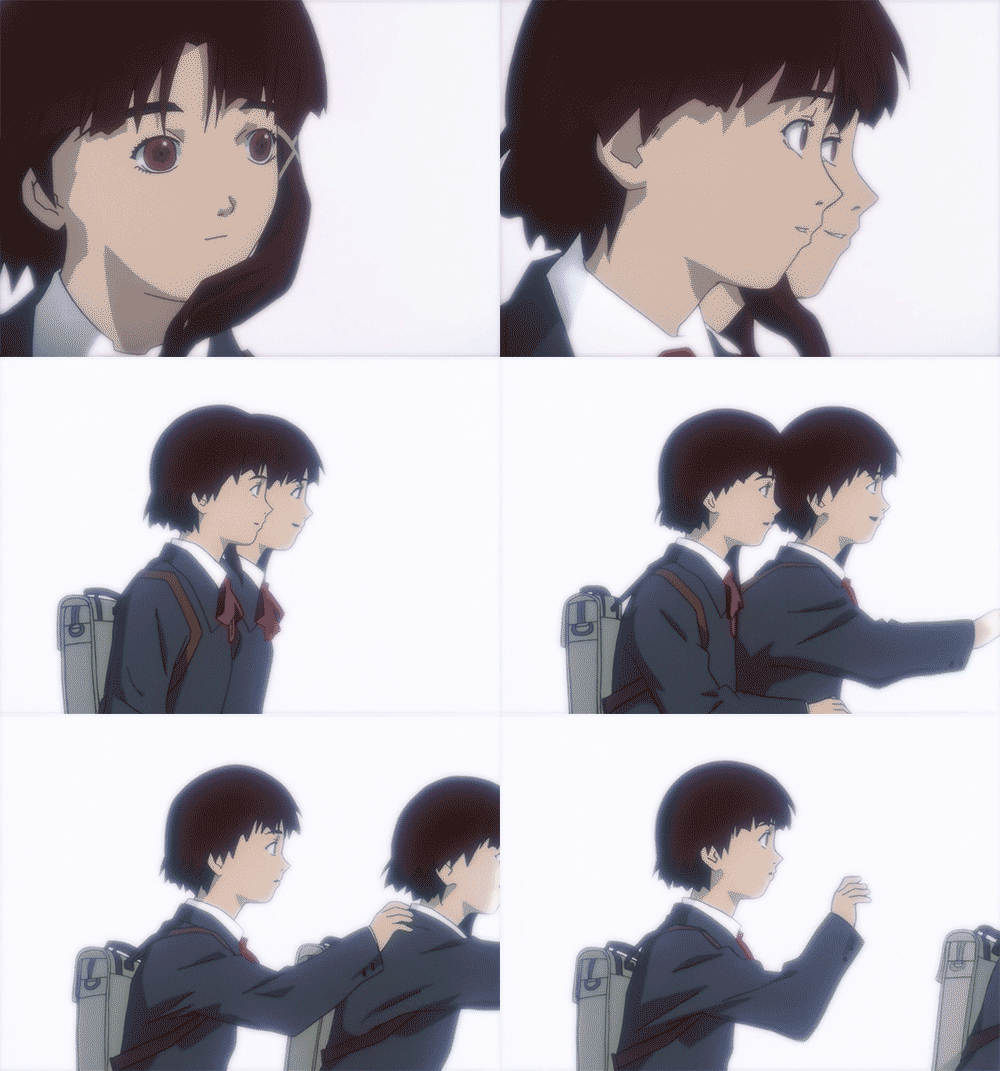
As Lain get obsessed with Wire her understood of who she is
becomes totally indescribable to her.
The shy and quiet girl from real world,
the confident and aggressive Lain from the Wire
fights each other to become the dominant one.
This intense trauma shift in the reality until
she no longer is able to distinguish real world
from digital world.
Lain wanted to be emotionally connected to others, to feel real,
and to have certainty of being human. But the farther she explored,
the more despaired at reaching any of those goals.
As a result, she becomes completely depersonalized.
She believes she is nothing more than a program.
At least for a time, she also believes her body is no longer necessary.
The Collective Unconscious
The narrative blurs the boundaries of mind. Since Lain is heavily linked to the network as the rest of humanity. Her individual self merges with the mind of millions affecting the perception of individual existence. As Lain goes deeper in this identity disorder, she starts struggling to recognize herself. She feels like an outside observer watching her own actions. At the moment this happens is not only that she does not know who she is, but also that whatever she is it is just part of the Wire. The Wired functions almost like a technological version of Carl Jung's collective unconscious: a space where individual minds become interconnected. As Lain's identity merges with this network, she risks losing the boundaries that distinguish her from others. People need connection to others in order to be healthy. Sometimes, the loose/social connections we get on the internet (or the Wired) are not as good as those in-person. For Lain she needed that moment with Arisu up close and personal, or she would have been lost. It was thanks to Arisu that Lain realized she was real again, as well as starting to respect the importance of a human body. Human body as vessel makes us distinct from other self. Make us feel alive, because it allow us get in touch with sensible world. Sensible world is pain, fear and pleasure, but is also gentle, lovely and protector. The negativity of other define us, it helps us to define who we are.
God and perfection
It is said that God is the only perfect being that could exist. Eiri Masami attempted to become an omnipresent god of the Wired. So he needs to be perfect. He realizes that perfection means somehow the capacity to do anything to other perspective, to be capable to change the matters and reality. Since in the Wired everything is possible, then God can only exist in the Wired, but if that is the case real world cannot exist. His plan is then blur the boundary between real world and the Wire stealing humanity of its connection with the world. Eiri Masami views godhood as a state of pure, omnipotent omniscience, unburdened by flesh. He seeks to upload all of humanity's consciousness into the Wired to create a hive-mind that he controls. By stripping away physical limitations and human flaws, he envisions a perfect reality. He attempts that by equating perfection with total, sterile control. Lain, however, realizes that true godhood is defined by empathy and sacrifice, ultimately rejecting absolute power to embrace human imperfection, emotion, and connection She is defined by love and suffering. Lain’s ultimate conclusion is that living as a human—experiencing loneliness, pain, and the certainty of a physical lifespan—is more valuable than a flawless, immortal existence. She chooses to "erase" herself from others' memories to save humanity from the collective hive-mind, proving that the acceptance of imperfection is exactly what makes life meaningful. The series also contains strong religious imagery. Although not explicitly Christian in its message, Lain's final sacrifice invites comparison with Christian themes of redemption and self-sacrifice. Lain embodies the role of Jesus Christ when He is at the Garden of Gethsamane, hours before His execution: She struggles with the decision to erase herself from the memory of humans. She fights with herself, wondering things like, “Why do I exist?” She is literally at conflict with herself as she talks and argues with a doppelganger. Jesus died for everyone. The great equality in Christianity is that Jesus died for Jew and Gentile alike. He loved everyone. Lain, too, loves everyone, and sacrifices her life, in effect, because of that love. Her father understands her true feelings. Through speaking with her dad, Lain gathers strength to do what she will.
Conclusion
More than twenty years after its release, Serial Experiments Lain remains relevant because the questions it asks have only become more pressing. Social media, online identities, virtual communities, artificial intelligence, and transhumanist aspirations all force us to reconsider what it means to be human. Lain ultimately suggests that identity cannot be reduced to information alone. Human beings are not merely data; they are embodied, imperfect, and connected to one another through experiences that no network can fully replace.